Led by Béatrice Ledésert and his team, this innovation wins the device SCI-TY promises to transform the construction sector by significantly reducing the heating and air conditioning needs of buildings. The HiTS (High-Tech Soil-materials for Sustainable Construction) project is paving the way for more sustainable and energy efficient construction.
Hello Beatrice, could you tell us more about you?
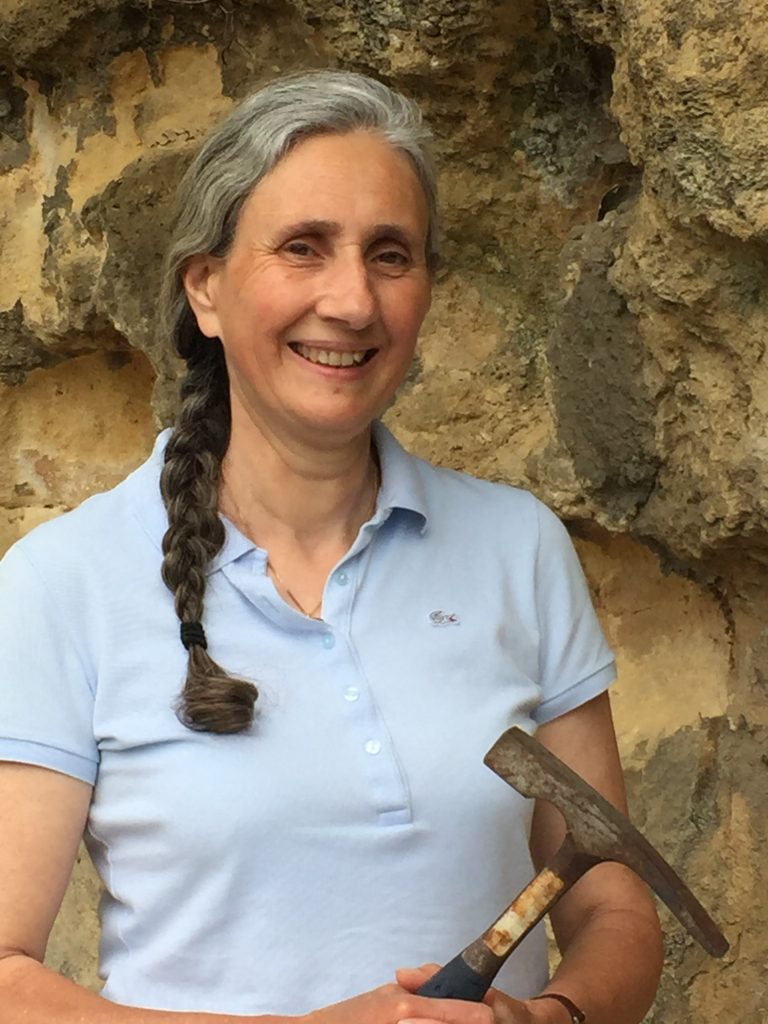
Béatrice Ledésert, Professor of Geoscience and the Environment at CY Cergy Paris University, ISTeP laboratory (ex-GEC), wishing to work for the environmental and energy transition through innovative and reduced impact building materials: solid-solid phase change materials (MCP s-s).
What is your project?
The MCP s-s at the heart of this project are the result of a fruitful collaboration between CY GEC laboratories (now CY ISTeP) and CY LPPI, in partnership with CY L2MGC. They are therefore at the edge of chemistry, environmental protection and civil engineering. These MCP s-s reduce the need for heating and air conditioning of buildings thanks to the thermal phase shift that characterizes them: they charge energy during the solar phases and release it during colder periods (for example at night). Currently the technology is at a TRL 3-4 stage and targets level 9 through various ongoing and future projects).
How is this technology valued?
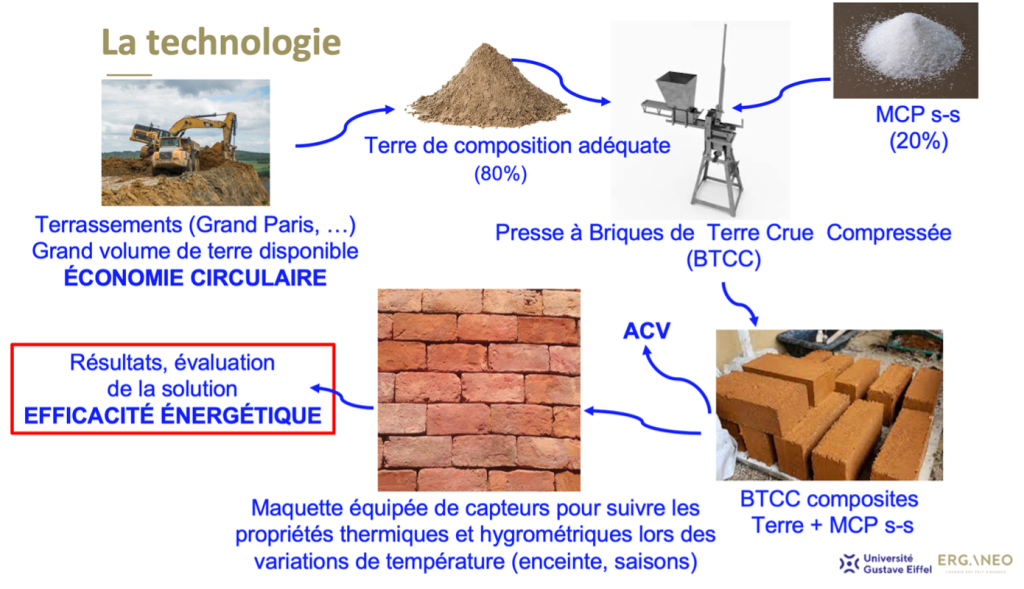
The MCP s-s project allowed the filing of a patent (Harlé et al., 2017a) and its international extension (PCT, Harlé et al., 2017ab) and several publications (Harlé et al., 2019, Plancher et al., 2021 a and b, Harlé et al., 2022). Numerous contacts have been established with industrialists in a variety of sectors which have asked to test samples. The MCP s-s have already benefited from a maturation project of the SATT IDF Innov (postdoc of 18 months), an INEX project of 1 year (BUSY project, head of Dr Ronan Hebert, CY ISTeP) and a pre-maturation project ADEME / SATT Erganeo within the framework of the Sci-Ty project (post-doc of 1 year) named Hits (High-Tech Soil-materials for sustainable construction). The latter aims to produce compressed raw earth bricks (BTCC) with a circular economy objective (recycling of excavated land in Greater Paris). S-MCPs will be incorporated into BTCCs to quantify their energy interest in this type of material. A life cycle analysis is planned to determine the environmental gain of PKM in raw land compared to other constructive solutions.
Thanks to Béatrice Ledésert for this interview and his explanations.