China continues to transform its higher education by strengthening the practical orientation of professional doctorates in engineering.
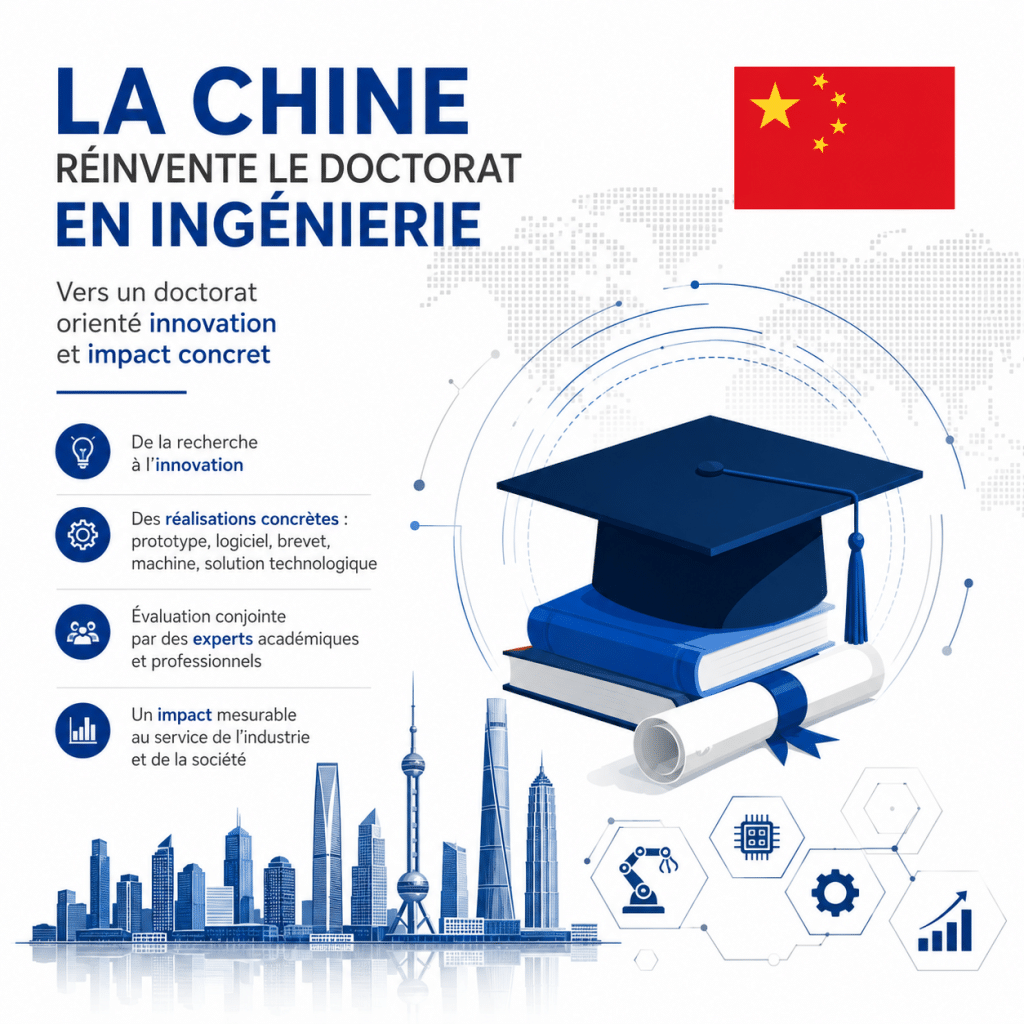
New guidelines published by the Chinese Ministry of Education now allow, in some professional doctorates in engineering, that graduation is based not only on an academic thesis but also on concrete achievements such as a prototype, software, patent, industrial process or other technological innovation, accompanied by a scientific report demonstrating their value and rigour.
This development is part of a strategy to strengthen the links between research, innovation and industrial development. The PhD students' work will be assessed both on their scientific quality and on their ability to meet concrete needs, with the involvement of experts from academia and industry.
Beyond the Chinese case, this reform revives an international debate on the evolution of the doctorate: should doctoral training be assessed only through the production of new knowledge, or also by its ability to generate innovations with an economic, technological and societal impact?
Without questioning the importance of basic research, this approach demonstrates a desire to better articulate scientific excellence, technology transfer and value creation.
In a context of global scientific and technological competition, it will be interesting to see whether France will use this model to accelerate innovation, or whether it will propose a different, equally ambitious approach.
Sources
- Ministry of Education of the People China unveils new regulation for professional doctorate in engineering
- China Daily – Guidelines issued for engineering PhD.
- Official Chinese Government Portal – Guidelines issued for engineering doctorate (English.gov.cn)
Publication LinkedIn by Dr Rachid Boutti: « China redefines PhD in Advanced Engineering and Technology ».