
26 May 2026 8:00 27 May 2026 17.00
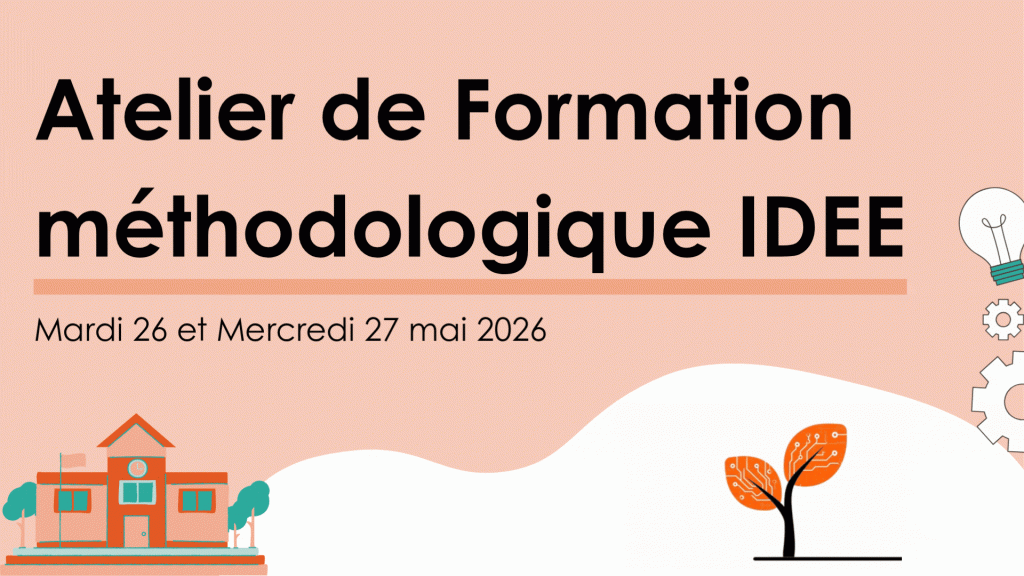
The programme Innovations, Data and Experiences in Education (IDEE) organise a free methodological training workshop Tuesday 26 and Wednesday 27 May 2026 at the School of Economics in Paris.
This workshop is aimed at young researchers from all disciplines to deepen their control of randomised experiments applied to the field of education.
Objectives of training
On two full days (including lunches and coffee breaks), participants will benefit from a programme structured around the following themes:
- Impact assessment methodologies
- Experimental designs of encouragement
- Statistical power and its determinants
- Research, Ethics and GDPR
- Attrition and strategies to limit it
- Practical implementation considerations
- An Individual project support of participants
The detailed agenda will be communicated later to the registered persons.
Method of registration
Applications open until Sunday 3 May 2026 (included).
To apply or ask a question, please contact:
Lucie Fourel (Senior Research Associate): lfourel@povertyactionlab.org
Applicants are invited to provide:
- A brief presentation of their profile
- Their area of expertise
- A description of a randomized experiment project (if applicable)
Participants must commit to be present on the two days.
Due to the limited number of places, quick registration is recommended.
Doctoral mobility grant
The IDEE programme proposes a mobility grant for doctoral students to finance their travel.
Applications must include: letter of support from the thesis director and be sent to the same contact address.
Note
The workshop will be followed by the closing event of the implementation phase of the IDEE programme, organised by the Thursday 28 and Friday 29 May 2026.
About the IDEE programme
The IDEE programme is a equipment of excellence dedicated to the development of large-scale experimental research in education and the exploitation of its results.
It is led by J-PAL Europe at the École d'Economie de Paris, coordinated by Université Paris Sciences & Lettres, and conducted in partnership with the Evaluation, Prospective and Performance Directorate of the Ministry of National Education.
The programme is also supported by a consortium of leading academic partners, including Sciences Po, Grenoble Alpes University and the Office of the Commissioner for Atomic Energy and Alternative Energy.
It receives state funding through the Investment for the Future programme managed by the National Research Agency (reference ANR-21-ESRE-0034).
For more information: https://www.idee-education.fr