How to collaborate with public research

How?

What forms can partner with the university for a company?

Depending on the nature of this partnership, different types of contracts exist. They each have their specific characteristics in terms of the duration and management of Intellectual Property (IP). All of this is summarized in the table below:
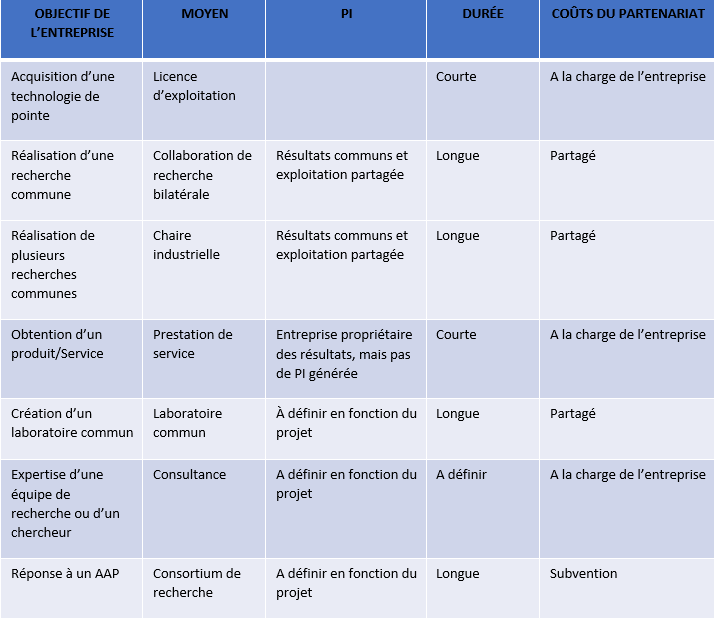
Table of collaborative tools

An additional tool exists: patronage. For more information, please contact CY Foundation

What benefits?

What benefits can a company have in collaborating with a university?

Research Tax Credit (IRC)

The IRC is a Tax arrangements enabling companies to generate a tax reduction calculated on the basis of R&D expenditure incurred by enterprises over the calendar year. The IRC is therefore a fiscal leverage, which aims to encourage research and development efforts (R&D) firms, regardless of their size and sector of activity. This scheme is governed by Article 244c(B) of the General Tax Code (GIC), which defines all the parameters and criteria that each undertaking must ensure to comply with in each CIR declaration. The tax deduction is 30% on the expenditure covered by the collaboration contract for basic research, applied research and experimental development.

Further information: CIR

Innovation Tax Credit (IIC)

Tax Credit Innovation is a tax measure reserved for SMEs. The latter can benefit from a tax credit of 20% of the expenses required to design prototypes or pilot installations for new products. The base is capped at 400 000€ by year and enterprise. The declaration is made using the same form Cerfa No. 2069-A-SD and in the same manner as the Crédit Taxe Recherche (CIR). Under certain conditions, SMEs may benefit from early repayment of their ITCs.

Further information: CII

Tax Credit Research Collaboration (CICO)

Section 69 of Finance Act 2022 created Tax Credit Research Collaboration (CICO) to encourage companies to engage in R&D through research collaborations with research and knowledge dissemination organizations.

Its main objective is to create a incentives for businesses (in particular SMEs and start-ups) engage in R&D in partnership research.

Its definition is part of the compliance with EU state aid rules
– A separate device from the CIR;
– Restriction on R&D expenditure incurred by firms by research and knowledge dissemination organisations (KDOs) as part of effective research collaboration;
– Compliance with aid intensities permitted by the General Block Exemption Regulation (GCR) on RDI aid.

The tax credit is equal to 50% eligible expenditure retained (up to EUR 6 million of declared expenditure) for SMEs. It is 40% for intermediate enterprises (ETI) and large enterprises (GE)up to EUR 6 million of declared expenditure.

There is no differentiation of rates between the different categories of R&D (basic research, applied research, experimental development).
These rates saturate the maximum aid intensities allowed for RDI State aid in the absence of differentiation between the different categories of R&D work.

Share this article

Read our others advice

File submission simplified !

On C4T, it is possible to apply for different types of projects, including:

  • Economic project
  • Service Delivery
  • Confidentiality Agreement (NDA)
  • Training and awareness raising
  • Protecting my search results


Target: A simplified platform for filing files in three clicks.

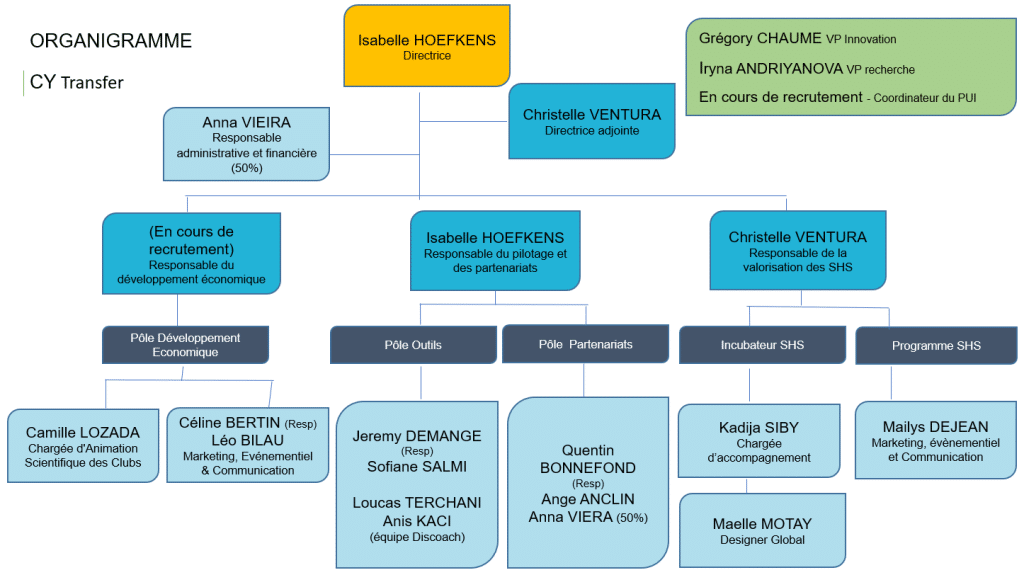
Organization chart of the operational team

Photo by Olivier Romain

Olivier Romain
Vice-President Innovation and Transfer for CYU

Christelle Ventura
Deputy Director in charge of Human and Social Sciences Development

Isabelle Hoefkens
Deputy Director, Project Management and Development Support

Odile Dubois
Deputy Director of Economic Development

Céline Bertin-Guillot
Marketing Manager

Quentin Bonnefond
Head of Partnerships

Jérémy Demange
Tools development

Anna Vieira
Responsible for administrative and financial management

Ange Anclin
Legal Assistant

Maïlys Dejean
Communications Officer

Célio Zanotti
Graphic designer

Kadija Siby
Responsible for the development and support of startups

The enhancement of the Human and Social Sciences, a unique characteristic, unique to the PUI CY Transfer.

In its strategy, the PUI CY Transfer has a special interest in the Human and Social Sciences: it is on its territory the operator of their socio-economic development. The PUI CY Transfer links SHS researchers to the concrete needs of local actors. Work on societal issues – whether social innovation, education, urban dynamics or digital transformation – is echoed in partnerships with communities, businesses and associations.


The mission of SHS is to ensure that the knowledge and expertise produced within the university is fully exploited to meet contemporary challenges.

The meeting app between researchers and innovators !

With Konekti, you have an application (web and mobile) for matching, which allows you to connect the laboratory staff of PII establishments (researchers, engineers, etc.) with the industrialists.

The objective: a simpler and faster contact between the academic world and companies.